Artificial plant supplier quotes can look easy to compare: product description, unit price, minimum order quantity, and lead time. In practice, two quotations that appear to cover the same artificial tree may represent different sizes, foliage density, materials, pots, packaging methods, quality standards, payment terms, and shipping responsibilities. The lowest unit price can therefore produce the highest landed cost—or a product that cannot meet the buyer’s retail target.
This guide gives wholesalers, distributors, e-commerce sellers, and home-decor retailers a structured way to compare artificial plant supplier quotes. It focuses on specifications, samples, MOQ, tooling, packaging cube, Incoterms, quality control, compliance, and the full cost of getting saleable goods into inventory.
Why Unit Price Is Not a Complete Comparison
A quotation is meaningful only when every supplier prices the same commercial requirement. A 180 cm artificial olive tree may vary substantially in canopy width, leaf count, trunk construction, pot size, net weight, branch structure, color treatment, assembly method, and carton volume. A price difference may reflect a genuine efficiency advantage, but it may also reflect a different product.
The objective is not to force every supplier to offer the lowest number. It is to make the offers comparable, identify assumptions, and calculate which option supports the best combination of product quality, margin, supply reliability, and customer experience.
1. Send One Standard RFQ to Every Supplier
Begin with a written request for quotation rather than sending only a reference photo. Use the same RFQ format, target quantity, destination, and deadline for each supplier. If a requirement is unknown, ask suppliers to state their assumption instead of leaving the field blank.
- Product name, reference image, intended retail channel, and target market.
- Finished height and the exact measurement method.
- Target canopy width, foliage density, leaf or branch count where practical.
- Leaf, stem, trunk, pot, filler, wire, adhesive, and coating materials.
- Natural wood, molded trunk, fiberglass, or mixed construction.
- Required colors, finishes, labels, barcodes, and private-label packaging.
- Target quantities by SKU, size, and color.
- Preferred trade term, named place or port, and quotation currency.
- Required sample date, production lead time, and shipment window.
- Inspection, testing, documentation, and destination-market requirements.
If you are still defining the product, review what artificial trees are made of. Material choices affect appearance, flexibility, odor, durability, weight, and cost.
2. Normalize the Product Specification
Create a comparison sheet with one row for every specification. Do not treat similar marketing names as proof of equivalence. Record what each supplier actually offers and highlight every deviation from the RFQ.
| Comparison field | Questions to verify | Why it affects cost |
|---|---|---|
| Finished size | How are height and canopy width measured after shaping? | Larger dimensions may use more material and carton space. |
| Foliage density | How many leaves, stems, or branch clusters are included? | Density strongly affects realism, labor, and material cost. |
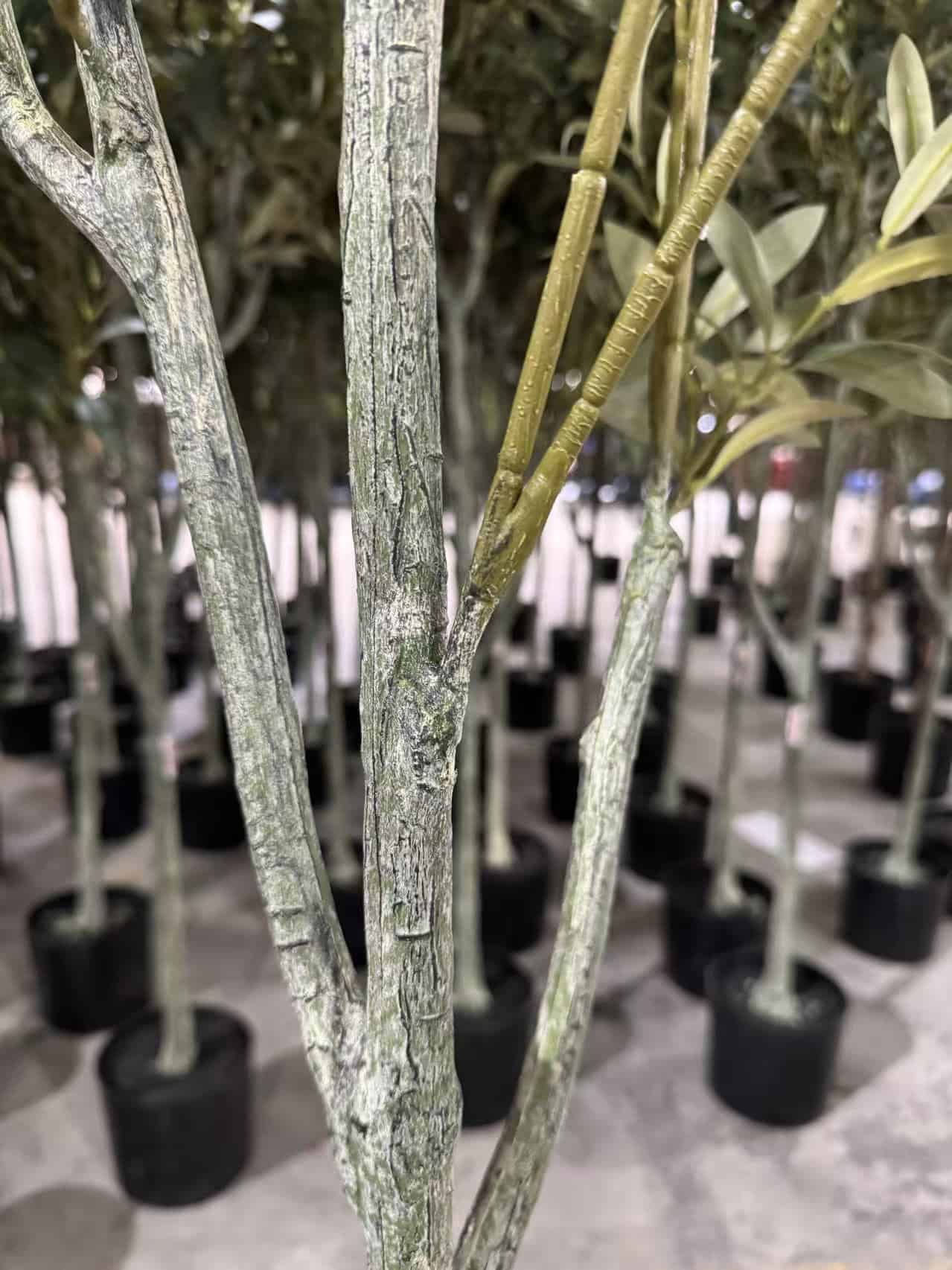
| Trunk construction | Natural wood, molded plastic, wrapped wire, or fiberglass? | Construction changes appearance, weight, consistency, and assembly. |
| Nursery pot | Dimensions, material, filler, weight, and reinforcement? | The pot affects stability, damage risk, and freight weight. |
| K/D structure | How many sections, what connectors, and what assembly time? | K/D design can reduce cube but adds hardware and customer setup. |
| Carton | Units per carton, external dimensions, gross weight, and board specification? | Carton volume directly affects freight and handling economics. |
Where a lower-cost offer changes the specification, calculate whether the change is acceptable to the customer. A smaller pot, narrower canopy, reduced leaf density, thinner wire, or lighter carton may be commercially reasonable for one price tier and unsuitable for another.
3. Compare Samples, Not Only Spreadsheets
Written specifications cannot capture every visual and tactile difference. Order samples built to the quoted specification and label each one with the supplier, version, date, and quotation reference. Shape all samples using the same method and evaluate them under similar lighting.
- Overall silhouette, balance, foliage distribution, and realism.
- Leaf shape, print alignment, color variation, surface finish, and edge quality.
- Visible glue, exposed wire, mold flashing, paint transfer, or loose parts.
- Branch flexibility, positioning range, and recovery after unpacking.
- Trunk appearance, connection quality, stability, and pot construction.
- Actual dimensions, net weight, assembly time, and shaping time.
- Packaging condition, carton dimensions, protection, and unpacking experience.
The approved sample should be supported by a signed specification and defect list. Our artificial tree quality inspection checklist provides a framework for turning subjective expectations into measurable approval criteria.
4. Separate Unit Price From One-Time Costs
Ask suppliers to separate recurring unit costs from tooling, molds, artwork, testing, sampling, packaging development, and setup charges. A quotation should explain whether these costs are charged in advance, amortized into the order, refundable after a volume threshold, or owned by the buyer.
- Sample price and international courier cost.
- New leaf, fruit, pot, trunk, connector, or accessory tooling.
- Packaging die lines, printing plates, color proofs, and barcode setup.
- Laboratory testing and document preparation.
- Third-party inspection or factory audit fees.
- Small-order, mixed-SKU, or special packing surcharges.
- Bank charges, credit costs, and currency-conversion assumptions.
For a fair comparison, allocate one-time costs across the realistic order volume rather than ignoring them or spreading them over an optimistic multi-year forecast.
5. Understand MOQ at Three Levels
“MOQ” may refer to the minimum per SKU, minimum per color or size, and minimum total order value. It may also be constrained by raw-material batches, printed-carton quantities, production-line setup, or container efficiency. Ask the supplier to break down each limit.
- Minimum quantity per model, size, and color.
- Minimum order value for the complete purchase order.
- Minimum custom material, print, or packaging quantity.
- Rules for mixing products within a carton or production run.
- Price changes at specific quantity tiers.
- Whether surplus printed packaging or custom materials must be purchased.
- Reorder MOQ and lead time after the initial program.
A slightly higher unit price with a flexible assortment can reduce inventory risk and improve cash flow. Compare the supplier’s MOQ with your expected sell-through, warehouse capacity, and working-capital plan.
6. Compare Packaging Cube and Container Yield
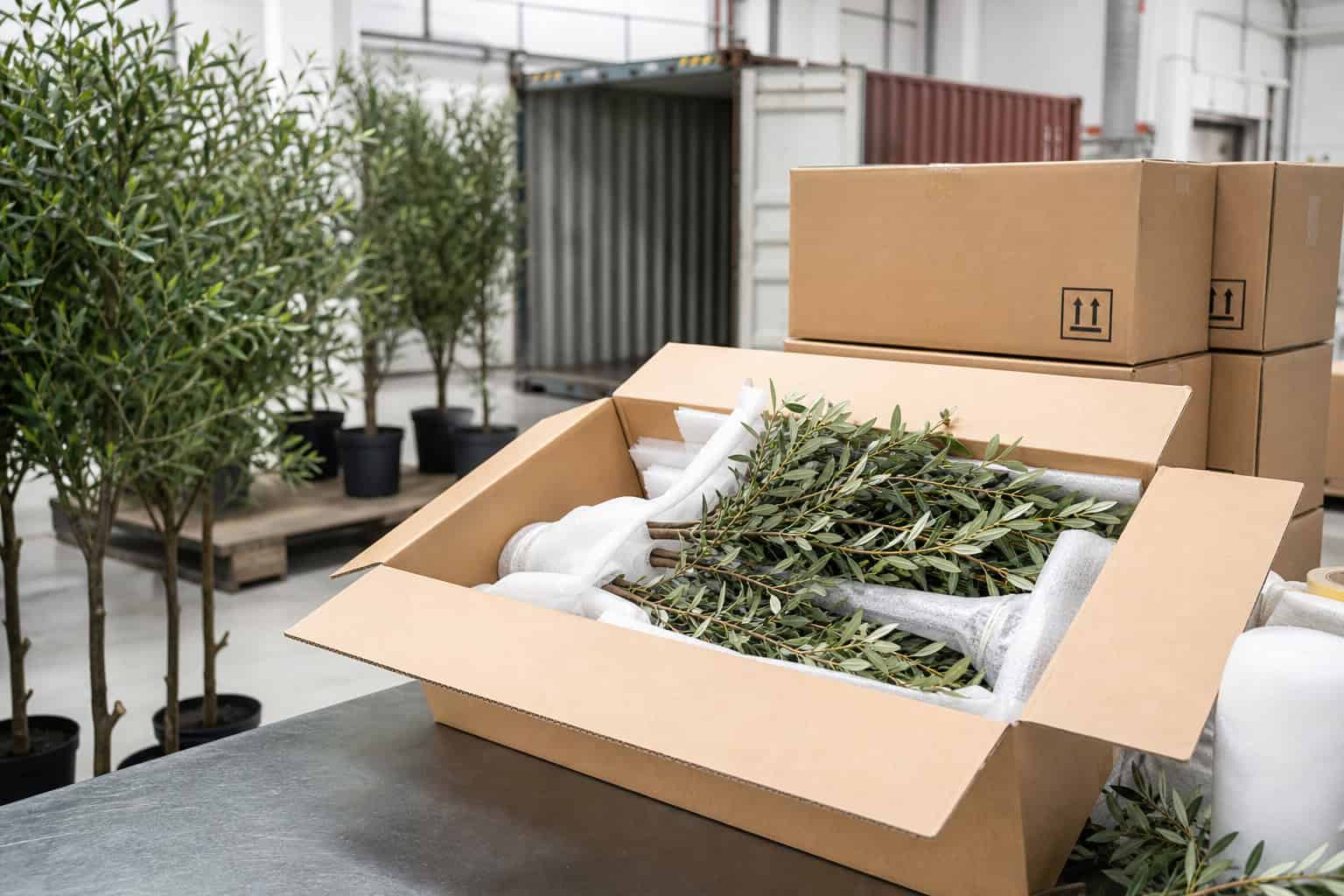
Artificial trees are often volume-sensitive products. A quote that saves one dollar per unit may lose that advantage if the carton is substantially larger. Request the external carton dimensions, packed quantity, gross weight, and an estimated loading quantity for the proposed container type.
Do not accept loading quantity based only on theoretical cubic volume. Ask for a layer-by-layer plan using finished carton dimensions and confirm door clearance, orientation, loading access, voids, and weight distribution. The supplier should clearly state whether the quantity is an estimate or the result of a trial load.
Evaluate any proposed compression or knock-down design with the packed sample. Our artificial plant packaging guide explains how to assess carton protection, compression recovery, testing, and container utilization. You can also review how K/D structures reduce shipping cost.
7. Put Incoterms and Named Places on Every Quote
A price marked EXW, FOB, CIF, or DDP is incomplete without the exact named place, port, or destination and the agreed version of the rule. ICC Incoterms® 2020 rules clarify how costs, risks, and obligations are allocated between buyer and seller. They do not, by themselves, define product quality, payment terms, title transfer, remedies, or every import requirement.
- Write the rule and named place precisely, such as “FOB [named port], Incoterms® 2020.”
- Confirm who books and pays each transport stage.
- Identify when risk transfers from seller to buyer.
- Confirm export and import clearance responsibilities.
- State insurance responsibility and required coverage where relevant.
- List destination charges that are excluded from the supplier’s price.
Ask a qualified freight forwarder or trade professional to review the term for the actual route. Do not compare an EXW price from one supplier with a FOB or delivered price from another without adding the missing services and risks.
8. Build a Landed-Cost Model
Landed cost is broader than the factory invoice. The International Trade Administration describes landed cost as including the original product price, insurance, freight, tariffs and taxes, and other fees. Your model should use destination-specific rules and actual quotations from logistics and customs professionals.
| Cost layer | Typical items |
|---|---|
| Product | Unit price, custom materials, packaging, tooling allocation |
| Origin | Pickup, export handling, documentation, terminal and clearance charges |
| International transport | Ocean or air freight, fuel or route surcharges, insurance |
| Destination | Port or terminal charges, broker, inspection, delivery, demurrage risk |
| Import | Duty, VAT or sales tax, other destination levies where applicable |
| Quality risk | Inspection, testing, expected defects, returns, rework, spare parts |
| Inventory | Financing, storage, slow-moving stock, markdowns, and obsolescence |
Customs valuation is not simply whatever value is convenient for the quotation. The WTO customs valuation framework generally begins with transaction value—the price actually paid or payable—subject to conditions and required adjustments. Classification, valuation, duty, and tax treatment must be confirmed for the importing country.
9. Evaluate Payment Terms and Cash Exposure
Two identical prices can create different financing costs and risks. Record the deposit, balance trigger, payment method, currency, validity period, and treatment of bank charges. Understand what evidence is required before the balance becomes due.
- Deposit percentage and due date.
- Balance timing: before shipment, against documents, or another agreed milestone.
- Quotation validity and price-adjustment conditions.
- Currency and responsibility for transfer fees.
- Sample, tooling, testing, and inspection payment timing.
- Remedy if production, quality, or shipment does not meet the contract.
Payment terms should be agreed with appropriate legal, banking, and trade advice. A low price does not compensate for unclear acceptance criteria or a payment structure that removes leverage before quality is verified.
10. Verify Capacity, Lead Time, and Reorder Reliability
Ask what the stated lead time starts from: deposit receipt, final sample approval, artwork confirmation, or material arrival. Separate sample development, pre-production approval, mass production, inspection, corrective action, and booking time.
- Current production schedule and peak-season capacity.
- Critical materials or components sourced from outside suppliers.
- Expected sample and pre-production approval dates.
- Daily or weekly capacity for the quoted product mix.
- Inspection window and time reserved for corrective action.
- Reorder lead time and method for controlling color or material consistency.
- Process for notifying the buyer of a delay or specification change.
Capacity claims should be verified in proportion to order risk. A factory audit, production records, sample performance, references, and a controlled pilot order can provide stronger evidence than a sales presentation alone.
11. Price Quality Control and Compliance Explicitly
Ask what inspection is included in the unit price and what is optional. Define the approved sample, tolerances, defect classification, sampling plan, testing, and documentation before placing the order. If independent inspection is required, state who appoints and pays the inspector and what happens after a failed result.
- Incoming material checks and pre-production sample approval.
- In-process checks for assembly, color, and component attachment.
- Final random inspection and agreed defect limits.
- Packaging, barcode, quantity, and carton-mark verification.
- Product-specific chemical, labeling, or performance documents.
- Corrective action, reinspection, and responsibility for nonconforming goods.
Do not assume a generic test report covers the quoted product. Confirm that documents identify the relevant materials, colors, construction, test method, laboratory, date, and destination requirement.
12. Score Commercial Risk, Not Just Cost
A weighted scorecard helps prevent the lowest visible price from dominating the decision. Adjust the weights for your sales channel and product risk.
| Evaluation area | Example weight | Evidence |
|---|---|---|
| Product and sample quality | 25% | Measurements, visual review, functional checks |
| Landed cost and margin | 25% | Normalized cost model and logistics quotations |
| Packaging and freight efficiency | 15% | Packed sample, carton data, loading plan, test results |
| Quality system and compliance | 15% | Inspection plan, records, relevant reports |
| Delivery and capacity | 10% | Production plan, pilot order, reorder performance |
| Communication and change control | 10% | Response quality, documented assumptions, issue handling |
The percentages are only an example. Record evidence and uncertainty as well as the numeric score. A supplier should not receive full credit for an unverified promise.
Red Flags in Artificial Plant Supplier Quotes
- The product description is vague and has no measurable specification.
- The quotation uses “same as photo” without an approved physical sample.
- Carton dimensions or loading quantities are missing or described as guaranteed without a packing trial.
- The Incoterm has no named place, port, or version.
- Testing or compliance claims rely on unrelated or expired reports.
- Tooling ownership, refund conditions, or custom-material liability is unclear.
- Lead time has no defined starting point or approval milestones.
- Price changes are allowed without a documented trigger or buyer approval.
- Payment is due before the buyer can verify agreed quality.
- The supplier discourages inspection or refuses to document corrective action.
Supplier Quote Comparison Checklist
- All suppliers received the same RFQ and quantity assumptions.
- Specifications and samples are normalized before price comparison.
- Unit price, tooling, testing, packaging, and surcharges are separated.
- MOQ is recorded per SKU, color, total order, and custom material.
- Carton dimensions and realistic loading quantities are confirmed.
- Incoterm, named place, currency, and price validity are stated.
- Landed cost includes logistics, import charges, quality risk, and inventory effects.
- Payment terms and acceptance milestones are documented.
- Capacity, lead time, inspection, and compliance evidence are verified.
- A weighted scorecard supports the final sourcing decision.
Frequently Asked Questions
Why do artificial plant supplier prices vary so much?
Prices may reflect differences in product size, foliage density, materials, trunk and pot construction, labor, quality control, packaging, MOQ, trade terms, and customization. Normalize the specification and packed sample before concluding that one supplier is simply cheaper.
Should buyers compare EXW or FOB quotes?
Use the trade rule that matches your purchasing and logistics plan, but compare every offer on the same cost boundary. An EXW and FOB quote are not directly comparable until the missing origin transport, handling, clearance, costs, and risks are added.
How should tooling cost be compared?
Confirm what the tooling produces, who owns it, where it is stored, expected life, maintenance responsibility, exclusivity, refund or amortization terms, and what happens when the relationship ends. Allocate the cost across a realistic volume.
Is the cheapest artificial plant quote usually the best?
No. The best commercial offer is the one that meets the approved specification and provides a competitive landed cost with manageable quality, delivery, compliance, and inventory risk. A lower price for a different product is not a saving.
Make the Final Decision With Comparable Evidence
The strongest artificial plant sourcing decision combines a controlled RFQ, comparable samples, a complete landed-cost model, clear contractual terms, and verified production evidence. When every assumption is visible, buyers can negotiate intelligently and select a supplier for repeatable value—not just an attractive first number.
For the complete sourcing workflow, read The Complete Guide to Wholesale Artificial Plants. Buyers ready to discuss specifications, samples, MOQ, packaging, and quotation options can contact Sinleen.